




Lease accounting software helps businesses manage lease agreements, automate financial calculations, track lease liabilities, and maintain compliance with accounting standards such as ASC 842 (US GAAP) and IFRS 16 (International Financial Reporting Standards).
Managing leases through spreadsheets can become complicated when an organization handles hundreds or thousands of property, vehicle, equipment, and other asset leases. Dedicated lease accounting platforms simplify this process through automated calculations, financial reporting, lease modifications, amortization schedules, and audit-ready documentation.
In this guide, we explore the top 9 lease accounting software solutions that help finance teams, accountants, auditors, and enterprise organizations streamline lease management and financial reporting.
TL;DR: Best Lease Accounting Software at a Glance
| Software | Best For | Key Strength |
| LeaseQuery (FinQuery) | Mid-sized and large businesses | Lease accounting automation |
| Visual Lease | Enterprise lease management | Lease administration |
| Nakisa | Global enterprises | Complex lease portfolios |
| Occupier | Real estate teams | Lease management and accounting |
| CoStar Lease Accounting | Commercial real estate | Real estate lease management |
| NetLease | NetSuite users | ERP integration |
| EZLease | Small and mid-sized businesses | Simple lease accounting |
| IBM TRIRIGA | Large enterprises | Integrated workplace management |
| SAP Contract and Lease Management | SAP environments | ERP-based lease management |
Note: Product capabilities, integrations, and compliance requirements should be verified with vendors before purchasing.
What Is Lease Accounting Software?
Lease accounting software is a financial management solution designed to record, calculate, monitor, and report lease-related financial transactions.
It helps organizations comply with accounting regulations by automatically calculating:
- Right-of-use (ROU) assets.
- Lease liabilities.
- Interest expenses.
- Depreciation expenses.
- Lease amortization schedules.
- Journal entries.
- Lease modifications and remeasurements.
- Financial statement disclosures.
Understanding ASC 842 and IFRS 16
ASC 842 is an accounting standard issued by the Financial Accounting Standards Board (FASB) in the United States. It requires lessees to recognize most leases on their balance sheets through right-of-use assets and lease liabilities.
IFRS 16 is an international accounting standard issued by the International Accounting Standards Board (IASB). It generally requires lessees to recognize right-of-use assets and lease liabilities for leases, subject to specific exemptions.
| Feature | ASC 842 | IFRS 16 |
| Accounting framework | US GAAP | International Financial Reporting Standards |
| Issuing organization | FASB | IASB |
| Balance sheet recognition | Most leases | Most leases |
| Lessee classification | Operating and finance leases | Generally a single lessee model |
| Right-of-use assets | Required for most leases | Required for most leases |
| Lease liabilities | Required for most leases | Required for most leases |
| Disclosure requirements | Extensive | Extensive |
These differences make it important to select software that supports the accounting framework applicable to your organization.
Top 9 Lease Accounting Software Solutions
1. FinQuery (formerly LeaseQuery)
FinQuery is a lease accounting and financial management platform designed to help businesses automate lease calculations, financial reporting, and compliance activities.
Formerly known as LeaseQuery, FinQuery provides solutions for organizations managing real estate, equipment, vehicle, and other lease portfolios.
Key Features
- ASC 842 and IFRS 16 compliance support.
- Automated lease liability calculations.
- Right-of-use asset tracking.
- Lease amortization schedules.
- Journal entry automation.
- Financial reporting and audit support.
- ERP integrations.
- Lease portfolio management.
Best For: Mid-sized businesses, accounting departments, healthcare organizations, retail businesses, and enterprises managing multiple lease agreements.
Why Choose FinQuery?
FinQuery is a strong choice for finance teams that want to reduce spreadsheet-based accounting work and automate recurring lease calculations. It also supports integrations with popular ERP and accounting platforms.
Website: FinQuery Official Website
2. Visual Lease
Visual Lease is a lease accounting and administration platform that helps organizations manage lease portfolios, financial obligations, and compliance requirements in one centralized environment.
It supports organizations that need visibility into property, equipment, and other lease agreements.
Key Features
- ASC 842 and IFRS 16 compliance.
- Lease portfolio management.
- Automated accounting calculations.
- Lease abstraction and data management.
- Financial reporting.
- Lease modification tracking.
- Critical date notifications.
- Audit documentation.
Best For: Large enterprises, multinational organizations, corporate real estate teams, and finance departments.
Why Choose Visual Lease?
Visual Lease is particularly useful for organizations that want to connect lease administration with accounting operations. Its centralized approach helps finance and real estate teams work with consistent lease information.
Website: Visual Lease Official Website
3. Nakisa
Nakisa provides enterprise lease accounting and administration solutions for organizations managing complex lease portfolios across multiple locations and countries.
Its platform supports lease lifecycle management, accounting automation, and ERP connectivity.
Key Features
- ASC 842 and IFRS 16 compliance.
- Automated lease accounting.
- Global lease portfolio management.
- Contract lifecycle management.
- Lease modifications and renewals.
- Financial reporting.
- SAP and Oracle integration capabilities.
- Multi-entity lease management.
Best For: Large multinational companies, financial institutions, manufacturing businesses, and enterprises with complex lease structures.
Why Choose Nakisa?
Nakisa is a suitable option for organizations that require centralized lease administration and accounting across multiple legal entities. Its enterprise integration capabilities can help businesses manage complex financial operations.
Website: Nakisa Official Website
4. MRI ProLease
MRI ProLease is a lease management and accounting solution designed to help organizations manage real estate and equipment leases.
The platform supports financial reporting, lease administration, and accounting requirements for businesses with diverse lease portfolios.
Key Features
- ASC 842 compliance capabilities.
- IFRS 16 support.
- Lease administration.
- Automated accounting schedules.
- Lease payment tracking.
- Financial reporting.
- Lease portfolio visibility.
- Integration with business systems.
Best For: Commercial real estate companies, corporate property teams, and businesses managing multiple property and equipment leases.
Why Choose MRI ProLease?
MRI ProLease is worth considering when lease accounting is part of a broader real estate management strategy. It provides tools for connecting property information with financial and administrative workflows.
Website: MRI Software Official Website
5. Occupier
Occupier is a commercial real estate lease management platform that helps businesses organize property information, manage lease obligations, and handle accounting workflows.
It is designed to improve collaboration between accounting, finance, and real estate teams.
Key Features
- ASC 842 and IFRS 16 accounting capabilities.
- Lease administration.
- Real estate portfolio management.
- Lease document tracking.
- Financial reporting.
- Lease renewal reminders.
- Accounting workflow management.
- NetSuite integration.
Best For: Commercial tenants, retail businesses, growing organizations, and corporate real estate teams.
Why Choose Occupier?
Occupier is particularly relevant for organizations that want to manage real estate leases and accounting information together. It can help teams maintain visibility into lease terms, renewals, and financial obligations.
Website: Occupier Official Website
6. NetLease by Netgain
NetLease is a lease accounting solution developed by Netgain, with a focus on organizations using Oracle NetSuite.
It helps accounting teams automate lease schedules, calculations, and reporting without relying heavily on manual spreadsheets.
Key Features
- ASC 842 compliance.
- IFRS 16 support.
- Automated lease calculations.
- Lease amortization schedules.
- Journal entry generation.
- Financial reporting.
- NetSuite integration.
- Lease portfolio management.
Best For: NetSuite users, growing businesses, finance departments, and organizations looking for ERP-connected lease accounting.
Why Choose NetLease?
NetLease is a practical choice for businesses already using NetSuite. Its ERP-focused approach can reduce the need for disconnected accounting processes and manual data transfers.
Website: Netgain Official Website
7. EZLease
EZLease is a lease accounting platform from insightsoftware that helps organizations manage lease calculations and financial reporting.
It is designed to support businesses that need accounting automation without necessarily implementing a large enterprise lease administration system.
Key Features
- ASC 842 compliance.
- IFRS 16 support.
- GASB accounting support.
- Lease liability calculations.
- Right-of-use asset schedules.
- Journal entries.
- Disclosure reporting.
- Lease modification tracking.
Best For: Small and mid-sized businesses, accounting firms, equipment lessees, and finance departments.
Why Choose EZLease?
EZLease is worth evaluating if your primary requirement is accurate lease accounting and financial reporting. It offers a focused approach to lease calculations and compliance.
Website: insightsoftware Official Website
8. LeaseAccelerator
LeaseAccelerator is an enterprise-focused lease accounting and lifecycle management solution now associated with insightsoftware.
It helps organizations manage complex lease portfolios, automate financial processes, and maintain accounting compliance.
Key Features
- ASC 842 and IFRS 16 support.
- Enterprise lease management.
- Automated lease calculations.
- Lease lifecycle tracking.
- Contract management.
- Financial reporting.
- ERP integration capabilities.
- Lease modification management.
Best For: Large enterprises, multinational corporations, manufacturing businesses, and organizations managing extensive equipment and property leases.
Why Choose LeaseAccelerator?
LeaseAccelerator is worth considering for businesses with large and complex lease portfolios that require structured workflows, financial automation, and enterprise-level reporting.
Website: insightsoftware Official Website
9. Trullion
Trullion is an AI-powered accounting platform designed to simplify financial reporting, contract data extraction, and compliance workflows.
Its technology helps accounting teams extract information from lease documents and use that data in accounting processes.
Key Features
- AI-powered lease data extraction.
- ASC 842 and IFRS 16 support.
- Automated lease calculations.
- Contract document analysis.
- Financial reporting.
- Audit-ready workpapers.
- Lease modification tracking.
- Accounting workflow automation.
Best For: Accounting firms, finance teams, auditors, and businesses looking to introduce AI into lease accounting workflows.
Why Choose Trullion?
Trullion is a compelling option for organizations that want to reduce manual lease data entry. AI-assisted document processing can help accelerate lease abstraction, although important extracted information should still be reviewed for accuracy.
Website: Trullion Official Website
Lease Accounting Software Comparison Table
The following table summarizes the nine platforms based on their primary positioning and commonly advertised capabilities.
| Software | ASC 842 | IFRS 16 | Main Strength |
| FinQuery | Yes | Yes | Accounting automation |
| Visual Lease | Yes | Yes | Lease administration |
| Nakisa | Yes | Yes | Enterprise operations |
| MRI ProLease | Yes | Yes | Real estate management |
| Occupier | Yes | Yes | Commercial real estate |
| NetLease | Yes | Yes | NetSuite integration |
| EZLease | Yes | Yes | Lease calculations |
| LeaseAccelerator | Yes | Yes | Enterprise lifecycle management |
| Trullion | Yes | Yes | AI-powered accounting |
Note: This is a high-level product comparison, not an independent certification assessment. Confirm the exact reporting modules, supported accounting scenarios, and applicable regional requirements with each vendor.
Key Statistics About Lease Accounting Software
Lease accounting automation has become increasingly important as organizations manage more complex lease portfolios and reporting requirements.
Here are useful market and product research figures to consider:
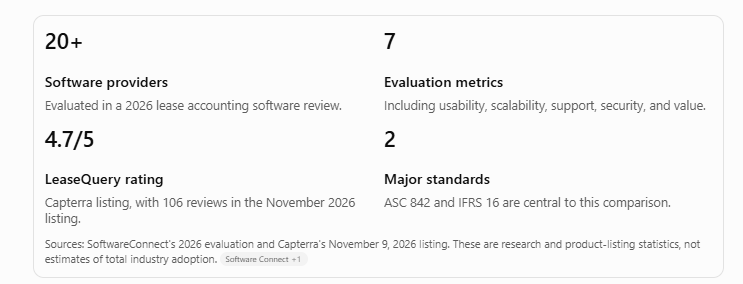
ASC 842 and IFRS 16 are central to this comparison.
Sources: SoftwareConnect's 2026 evaluation and Capterra's November 9, 2026 listing. These are research and product-listing statistics, not estimates of total industry adoption.
Software Connect+1
Important Lease Accounting Challenges for Businesses
Organizations commonly face these challenges when managing lease portfolios:
- Manual calculations: Spreadsheet-based calculations can increase the risk of errors.
- Compliance management: Businesses must apply the appropriate accounting standards.
- Lease modifications: Changes in lease terms can require recalculations.
- Multiple locations: Managing leases across different countries and entities can be complicated.
- Audit preparation: Finance teams need reliable records and supporting documentation.
- Financial reporting: Generating accurate disclosures requires organized lease information.
Essential Features to Look for in Lease Accounting Software
Before selecting a platform, businesses should evaluate the following capabilities.
1. ASC 842 and IFRS 16 Compliance
The software should support the accounting standards relevant to your organization and generate appropriate financial schedules and disclosures.
2. Automated Lease Calculations
Look for automated calculations of lease liabilities, right-of-use assets, interest expenses, and depreciation.
3. Lease Abstraction
Lease abstraction extracts important information from lease agreements, such as payment terms, commencement dates, renewal options, and termination clauses.
AI-powered abstraction can reduce manual data entry, but human verification remains important.
4. Financial Reporting and Audit Trails
The platform should provide journal entries, amortization schedules, disclosure reports, and historical records that support audits.
5. ERP and Accounting Integrations
Integration with systems such as SAP, Oracle, NetSuite, and Sage Intacct can help reduce duplicate data entry.
6. Lease Modification Management
Businesses frequently modify lease agreements. The software should support changes involving renewals, terminations, payment adjustments, and remeasurements.
7. Multi-Entity and Multi-Currency Support
Organizations operating internationally should consider multi-entity reporting, currency handling, and local accounting requirements.
How Much Does Lease Accounting Software Cost?
Lease accounting software pricing varies according to the size of the organization, number of leases, number of legal entities, implementation requirements, and additional modules.
Most established enterprise platforms use customized pricing rather than publishing a universal subscription price.
| Pricing Factor | What Affects the Cost? |
| Number of leases | Larger portfolios may require higher-tier plans |
| Number of users | More accounting and administrative users |
| Legal entities | Multiple subsidiaries and reporting structures |
| Integrations | ERP and financial system connections |
| Implementation | Data migration, configuration, and training |
| AI capabilities | Automated contract extraction and processing |
| Support | Dedicated implementation and ongoing assistance |
Common Pricing Models
- Subscription pricing: Monthly or annual software subscriptions.
- Enterprise licensing: Customized agreements for large organizations.
- Implementation fees: One-time configuration and onboarding expenses.
- Additional modules: Extra charges for advanced reporting, integrations, or specialized workflows.
Buying tip: Request a customized quote from at least three vendors. Compare the total cost of ownership rather than focusing only on the subscription price.
How to Choose the Best Lease Accounting Software
Selecting the right solution depends on your organization's accounting requirements, lease portfolio, and existing technology infrastructure.
Step 1: Identify Your Accounting Requirements
Determine whether your organization needs ASC 842, IFRS 16, or both.
Step 2: Evaluate Your Lease Portfolio
Consider the number of property, vehicle, equipment, and other leases you manage.
Step 3: Check ERP Compatibility
Ensure the platform integrates with your existing accounting and enterprise systems.
Step 4: Review Automation Capabilities
Compare automated calculations, lease abstraction, journal entries, and reporting functionality.
Step 5: Evaluate Security and Audit Features
Check access controls, data protection, approval workflows, and audit history.
Step 6: Request a Product Demonstration
Ask vendors to demonstrate actual lease scenarios, including modifications, renewals, terminations, and complex payment schedules.
Best Lease Accounting Software by Business Requirement
| Business Requirement | Recommended Software |
| Overall lease accounting | FinQuery |
| Enterprise lease management | Visual Lease |
| Global lease portfolios | Nakisa |
| Real estate management | MRI ProLease |
| Commercial property leases | Occupier |
| NetSuite integration | NetLease |
| Straightforward lease calculations | EZLease |
| Large enterprise portfolios | LeaseAccelerator |
| AI-powered lease abstraction | Trullion |
These are editorial recommendations based on product positioning, not a universal performance ranking.
Benefits of Using Lease Accounting Software
Improved Accounting Accuracy
Automated calculations reduce dependence on manual spreadsheet formulas and help maintain consistent financial records.
Better Regulatory Compliance
Dedicated platforms help businesses manage accounting requirements and prepare supporting financial reports.
Reduced Administrative Work
Automation can reduce repetitive data entry, calculation, and reporting tasks.
Improved Financial Visibility
Finance teams can monitor lease liabilities, upcoming payments, asset values, and contractual obligations.
Easier Audit Preparation
Centralized lease documentation and audit trails help accounting teams organize supporting evidence.
Better Lease Portfolio Management
Organizations can monitor multiple leases, locations, entities, and renewal dates from a centralized platform.
Frequently Asked Questions (FAQs)
FinQuery, Visual Lease, and Nakisa are strong options for businesses seeking lease accounting automation, compliance support, and portfolio management. The best choice depends on business size and accounting requirements.
ASC 842 lease accounting software helps businesses record lease liabilities and right-of-use assets, calculate lease expenses, generate journal entries, and prepare financial disclosures under US GAAP.
IFRS 16 accounting software helps organizations manage lease agreements, calculate right-of-use assets and lease liabilities, and prepare financial reports according to international accounting standards.
Yes. Several platforms, including FinQuery, Visual Lease, Nakisa, and Trullion, advertise support for both standards. Organizations should verify specific reporting requirements before implementation.
Yes. Small businesses can use focused solutions such as EZLease or other subscription-based platforms to automate calculations and manage lease records.
Many solutions offer ERP integrations. Depending on the platform, supported systems may include SAP, Oracle, NetSuite, and Sage Intacct.
Lease abstraction software extracts important contractual information from lease documents, including payment amounts, commencement dates, renewal clauses, and termination conditions.
Yes. AI can help extract lease information, identify important contract terms, automate document processing, and reduce manual data entry. Human review is still necessary to validate extracted information and accounting decisions.
Compare accounting compliance, automation features, integration capabilities, reporting tools, security, scalability, customer support, and total ownership costs. Request a demonstration before making a final decision.
Conclusion
Choosing the right lease accounting software can help organizations simplify financial reporting, automate lease calculations, and maintain compliance with ASC 842 and IFRS 16.
Solutions such as FinQuery, Visual Lease, Nakisa, MRI ProLease, Occupier, NetLease, EZLease, LeaseAccelerator, and Trullion offer different capabilities for businesses of varying sizes and requirements.
Before investing, evaluate your lease portfolio, accounting standards, ERP integrations, automation requirements, and budget.
The right platform can reduce manual accounting work, improve financial visibility, and make lease management more efficient.