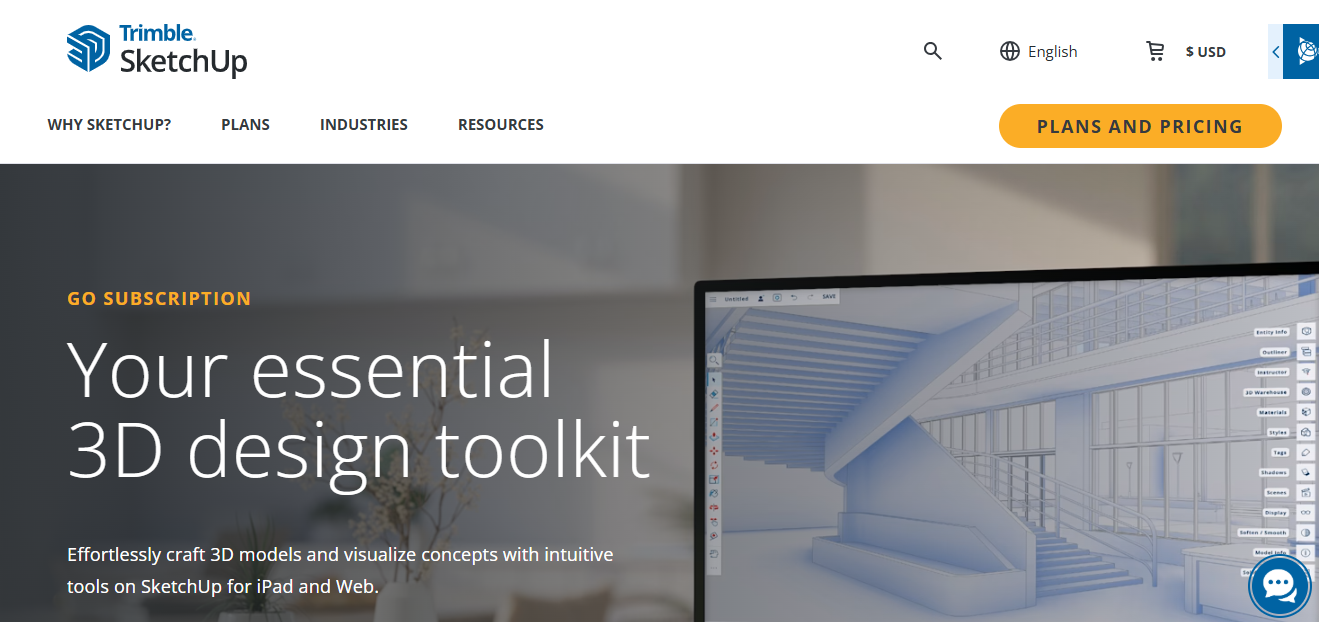
SketchUp is a popular, user-friendly 3D modeling and computer-aided design (CAD) software used for creating, viewing, and modifying 3D designs. Known for its intuitive "push/pull" technology, it is widely utilized by architects, interior designers, engineers, and builders to quickly turn concepts into 3D models.
SketchUp is a premier, intuitive 3D modeling application widely used for architectural design, interior design, urban planning, and engineering, known for its user-friendly "pencil-and-paper" approach to digital design. It enables users to create, view, and modify 3D ideas quickly through a push-and-pull interface.
Here is a detailed breakdown of SketchUp:
Core Functionality & Features:-
- Intuitive 3D Modeling: Built on a "push/pull" principle, enabling users to extrude any flat surface into a 3D shape.
- Accurate Drawing: Tools allow for precise, dimension-driven modeling based on a 3D axis system.
- Inference System: Assists in drawing accurate lines and shapes, such as identifying midpoints, intersections,
or parallel lines.
- Groups and Components: Allows organization of models, making it easier to manage complex designs, repeat objects (components), and reduce file size.
- Materials & Styles: Users can apply textures, materials, and colors to create realistic, stylized visualizations.
- Sections & Walkthroughs: Features specialized tools for creating sectional cuts, hidden line views, and navigating through 3D scenes.
Products and Ecosystem :
- SketchUp for Web: A cloud-based, free version for basic modeling, requiring only a browser and Trimble ID.
- SketchUp Pro: Desktop application featuring advanced tools, including LayOut for creating 2D construction documents.
- SketchUp Studio: High-end version, often including enhanced rendering for photorealistic visuals and BIM (Building Information Modeling) tools.
- 3D Warehouse: A vast, free repository of user-created models to import into projects.
- Extension Warehouse: Offers third-party plugins to expand capabilities, such as advanced rendering (e.g., V-Ray, Lumion).
Target Users:
- Architects & Designers: For conceptual design and schematic design.
- Interior Designers: For designing spaces, furniture, and layouts.
- Landscape Architects: For modeling outdoor environments and landforms.
- Engineers & Builders: For creating detailed models to minimize construction rework.
Key Benefits:
- Short Learning Curve: Considered easier to learn compared to many CAD alternatives.
- Rapid Visualization: Enables quick creation of 3D models from 2D concepts, helping clients understand projects better.
- Extensive Customization: Thousands of extensions are available to tailor the software to specific workflows.
Perspiciatis eos a